Steaming Technique: Stretching, Polishing, and Temperature Control
Steaming milk well is less about speed or instinct and more about understanding three distinct phases of work — each with its own purpose, its own sound, and its own relationship to the steam wand’s position in the pitcher. The baristas who produce consistently beautiful microfoam are not lucky; they have simply learned to listen, feel, and time these phases with the quiet discipline of someone weaving threads into cloth.
The Three Phases: Positioning, Stretching, and Polishing
Every steaming session moves through a clear sequence, and conflating the phases is the single most common source of foam problems.
Positioning is the brief, often overlooked setup before the steam valve opens fully. The tip of the wand should sit just below the surface of the cold milk — roughly 1–2 millimeters submerged — and offset slightly from the center of the pitcher. This off-center placement is what initiates the vortex, the spinning current that will later fold air into the body of the milk uniformly, rather than leaving it stranded at the surface in dry, brittle clumps. The wand should not press against the pitcher wall or rest at the very center; both positions kill the spin before it begins.
Stretching is the phase where air is introduced. With the steam fully open and the wand tip kissing the surface, you will hear a distinct, rhythmic chirping — sometimes described as a sharp paper-tearing sound repeated in quick succession. Each chirp represents a small parcel of air being drawn downward into the milk. The goal is controlled incorporation: enough air to build the foam’s body, but not so much that the texture becomes coarse. For a standard latte, stretching typically lasts only three to five seconds in a well-powered machine. The milk’s volume should increase by roughly a third, and no more. If the sound becomes a sustained, angry hiss, the wand tip has risen too far above the surface and is injecting large, unruly bubbles — the kind that will never integrate into a fine-grained weave.
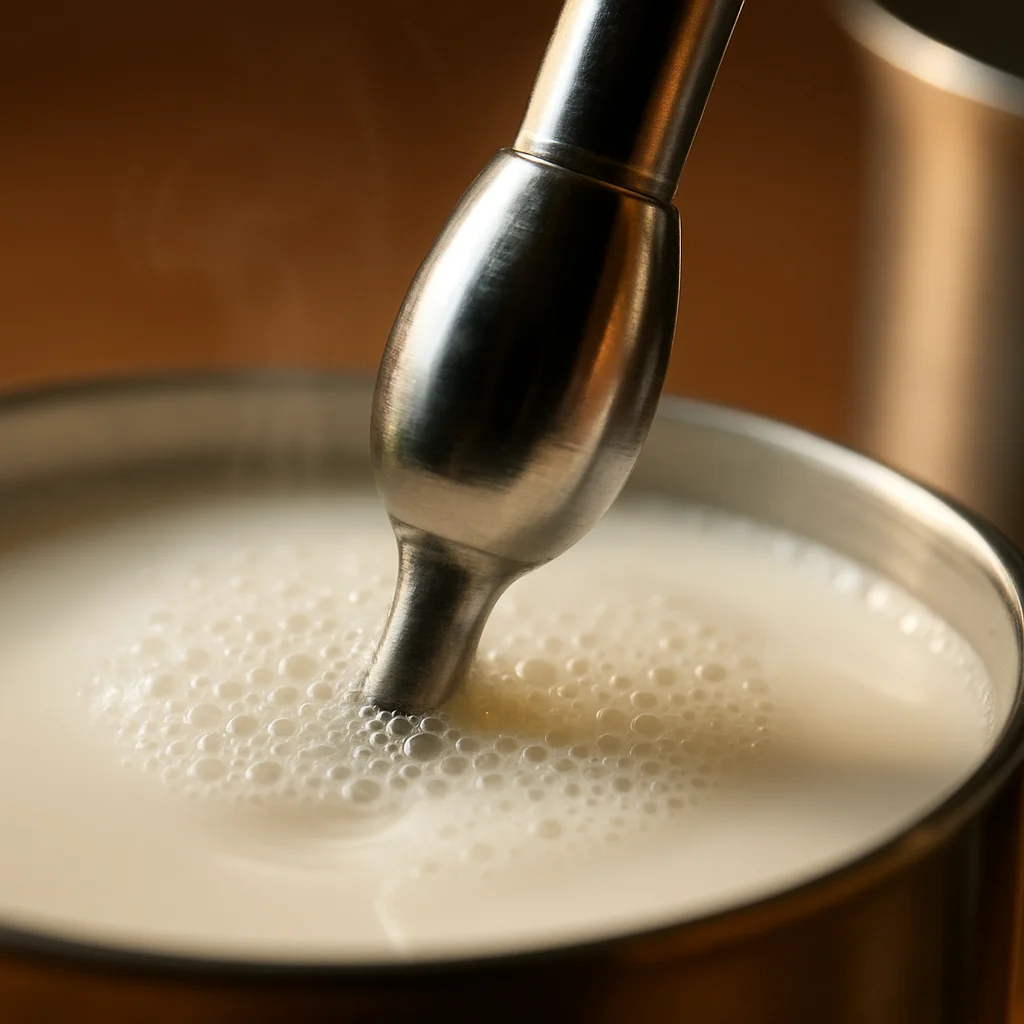
Polishing is the longer, quieter phase that follows. Once enough air has been introduced, the wand tip is lowered slightly deeper — just enough to silence the chirping entirely — while maintaining the vortex. The milk should now be spinning smoothly, folding the incorporated air into progressively smaller and more uniform bubbles. The sound shifts to a steady, low hum or a soft, rolling whir. This phase continues until the target temperature is reached. Polishing is what transforms a rough, bubbly liquid into the dense, glossy microfoam described in detail on the Microfoam Fundamentals page — the kind that looks like wet white paint pooling on porcelain.
Temperature: The Boundary You Cannot Cross
Milk proteins are the structural scaffolding of foam, and they are remarkably sensitive to heat. The sweet spot for steamed milk sits between 55°C and 65°C (131°F–149°F). Within this range, the whey proteins — particularly beta-lactoglobulin — unfold and stabilize the thin liquid walls surrounding each air bubble, giving the foam its tensile strength. Beyond 70°C (158°F), those same proteins begin to denature irreversibly, the fat globules lose their emulsified order, and the foam’s grain collapses into a flat, scorched liquid with a sulfurous edge. The chemistry behind this threshold is explored more fully in Milk Chemistry: Proteins, Fats, and Sugars Under Steam.
A reliable approach for those without a thermometer is the hand test: hold the base of the pitcher with your palm. When the metal becomes too hot to hold comfortably — not painfully, but distinctly uncomfortable — the milk is in the correct range. With practice, this tactile reading becomes remarkably precise.
Putting It Together
The entire sequence — position, stretch, polish, stop — rarely takes more than fifteen to twenty seconds on a capable espresso machine. What matters is the intentionality of each transition: the deliberate lowering of the wand tip to end the stretch, the sustained vortex during polishing, the decisive closure of the steam valve before the milk overheats. Rushing any phase, or allowing them to blur together, produces the kind of inconsistent foam that makes latte art feel like guesswork.
If your foam looks right in the pitcher but falls apart in the cup, the issue may lie in bubble structure and stability rather than technique alone — the Physics of Foam page covers that territory in depth. And for those whose results are erratic despite careful technique, the Troubleshooting guide walks through the most common failure patterns and their remedies.