Milk Chemistry: Proteins, Fats, and Sugars Under Steam
Milk is not a simple liquid. It is an emulsion, a suspension, and a solution all at once — a complex weave of proteins, fats, sugars, minerals, and water that behaves in remarkably different ways depending on how heat and mechanical force are applied. Understanding what happens to each of these components during steaming is the foundation upon which consistent, pourable microfoam is built. Without this understanding, troubleshooting foam problems becomes guesswork rather than craft.
Proteins: The Structural Thread of Foam
The proteins in milk are the single most important factor in foam creation and stability. They are, in every meaningful sense, the threads from which microfoam is woven.
Milk contains two broad families of protein: caseins, which account for roughly 80% of total milk protein, and whey proteins, which make up the remaining 20%. During steaming, it is the whey proteins — particularly beta-lactoglobulin and alpha-lactalbumin — that do the essential structural work. When heat is applied, these globular proteins begin to unfold, a process called denaturation. Their previously coiled structures stretch open, exposing hydrophobic (water-repelling) regions that were tucked inside. These newly exposed regions migrate to the air-water interface of each bubble, where they arrange themselves with hydrophobic sides facing the air and hydrophilic sides facing the liquid. The result is a thin, elastic protein film that encases each bubble, lending the foam its structure and resilience.
This denaturation begins in earnest around 40°C (104°F) and accelerates as temperature rises. The practical implication is significant: foam created at lower temperatures tends to be less stable because fewer proteins have unfolded and migrated to bubble surfaces. Conversely, overheating past roughly 65–70°C (149–158°F) causes excessive denaturation and aggregation — the proteins clump rather than stretch, the milk takes on a scalded taste, and the foam’s texture turns coarse and grainy. The narrow window between sufficient denaturation and protein damage is one reason temperature control during steaming matters so much, a subject explored in greater depth on the steaming technique page.
Caseins, meanwhile, play a supporting role. Organized in spherical clusters called casein micelles, they contribute to the viscosity and body of the steamed milk rather than to bubble stabilization directly. Their presence gives well-steamed milk that characteristic weight and flow — the quality that allows poured foam to hold a line on the surface of espresso.
Fats: Body, Sweetness, and the Cost of Richness
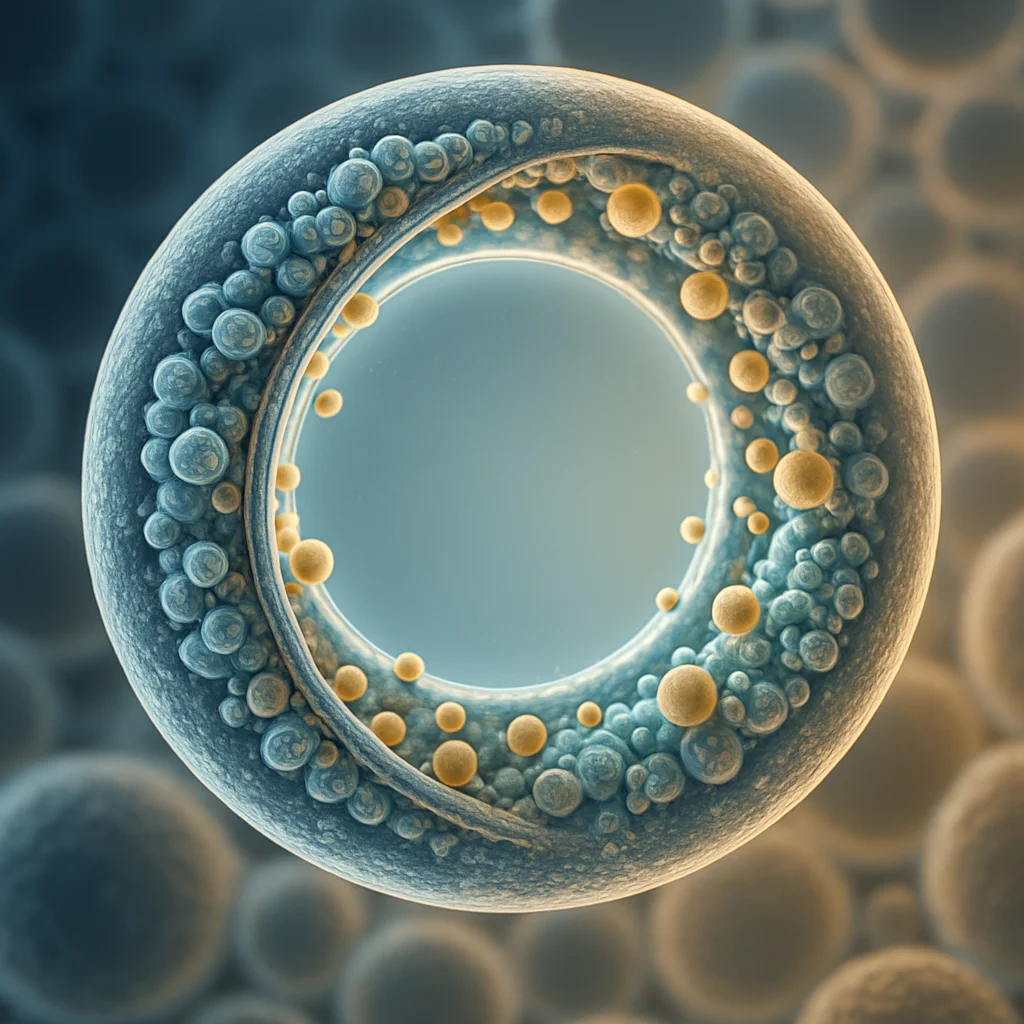
Milk fat exists as tiny globules suspended throughout the liquid, each surrounded by a membrane of proteins and phospholipids. Fat contributes enormously to the mouthfeel and perceived sweetness of steamed milk, but it comes with a trade-off: fat globules are inherently destabilizing to foam.
Fat molecules compete with proteins for space at bubble surfaces. Where a protein would form a strong, elastic film, a fat globule creates a weak point — a breach in the weave. This is why skim milk produces voluminous, stiff foam with ease, while whole milk yields a denser, more velvety but less persistent foam. The craft lies in balancing these qualities. For latte art, the moderate fat content of whole milk (typically 3.25–4%) tends to produce the best compromise: enough protein-driven stability for definition, enough fat for the fluid, painterly flow that allows patterns to hold their shape. The dairy milk comparison page examines these differences across specific fat percentages.
Sugars: The Quiet Contribution of Lactose
Lactose, the primary sugar in milk, does not participate directly in foam structure, but its behavior under heat shapes flavor profoundly. As milk is warmed to the 55–65°C range, lactose becomes more perceptible to human taste receptors, which is why properly steamed milk tastes noticeably sweeter than cold milk despite no sugar being added. True caramelization of lactose requires temperatures far above those reached in a steam pitcher — well over 150°C — so the sweetness experienced in well-steamed milk is a perceptual effect rather than a chemical transformation. Overheating, however, can trigger Maillard reactions between lactose and proteins, producing the flat, cooked flavor associated with scalded milk.
Bringing It Together
Every pour of latte art is, at its core, a negotiation between these three components — proteins building structure, fats enriching body while softening stability, and sugars sweetening the result within a narrow thermal window. A deeper understanding of bubble mechanics can be found on the physics of foam page, while those experiencing specific texture issues may find the troubleshooting guide a useful companion to the principles outlined here.