Frequently Asked Questions About Milk Steaming and Foam
Every question here has surfaced repeatedly in forums, behind espresso bars, and in the quiet frustration of watching a rosetta dissolve into a brown smear. The answers draw on the same principles explored across the rest of this site — protein behavior, bubble mechanics, and the tactile craft of working with steam — but gathered here in a format that lets you find what you need quickly.
Temperature and Timing
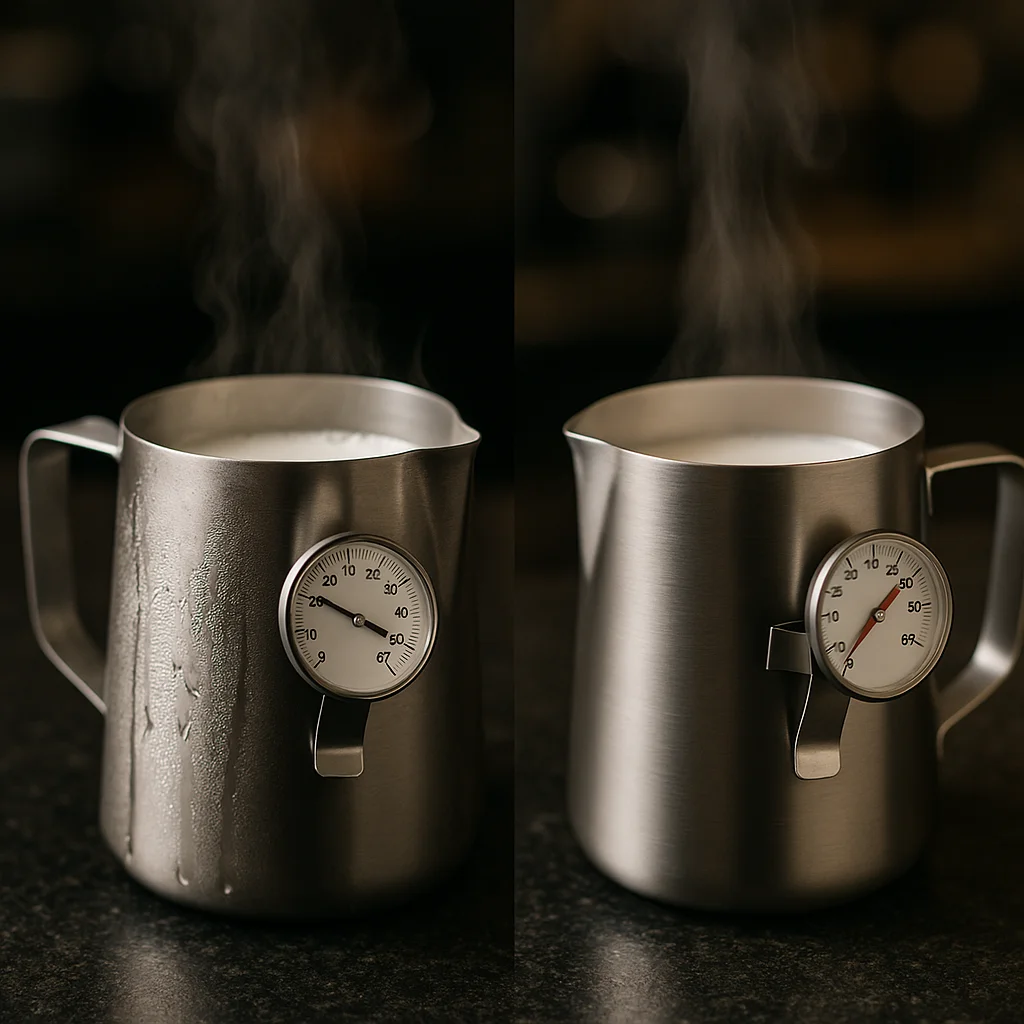
How hot should steamed milk actually be? The sweet spot for latte art sits between 55°C and 65°C (131–149°F). Within this range, lactose tastes its sweetest and the protein matrix holding your microfoam together remains intact. Once milk climbs past roughly 70°C (158°F), the whey proteins — particularly beta-lactoglobulin — denature beyond the point of usefulness, and the foam’s fine weave begins to unravel into dry, coarse bubbles. A detailed breakdown of this thermal threshold is covered in Milk Chemistry: Proteins, Fats, and Sugars Under Steam.
Can I re-steam milk that has already been heated? In practical terms, no. Milk that has been steamed once has already had its proteins stretched and recruited into the foam structure. Reheating it forces those proteins through a second round of denaturation, which yields a thin, flat texture with almost no capacity to hold air in stable micro-bubbles. The result pours like water with a skim of stiff froth sitting on top — the opposite of the integrated, paint-like consistency that latte art demands.
Does the starting temperature of the milk matter? It does, meaningfully. Cold milk straight from refrigeration (around 3–5°C / 37–41°F) gives you the longest window of steaming time before the liquid reaches its upper limit. That extra time is the fabric you work with: more seconds to incorporate air during the stretching phase and more seconds to polish the vortex smooth. Starting with room-temperature milk compresses that window considerably, making it much harder to achieve a fine, glossy microfoam.
Foam Texture and Quality
What does “microfoam” actually mean? Microfoam refers to milk in which the incorporated air is distributed as bubbles so small — typically well under one millimetre in diameter — that they are not individually visible to the naked eye. The surface should look like wet white paint pooling on porcelain: uniformly glossy, free of visible bubbles, with a slight viscosity when swirled. The full anatomy of this texture is explored on the Microfoam Fundamentals page.
Why does my foam separate into a stiff cap and thin liquid underneath? This is the hallmark of over-aerated or poorly integrated foam. Too much air was introduced during the stretching phase, or the polishing phase — the sustained vortex that folds large bubbles into progressively smaller ones — was cut short. The protein film around each bubble was stretched too far without being refined, so the foam’s grain is coarse and buoyant enough to float free of the liquid milk beneath it. The Troubleshooting Foam Problems guide walks through corrective adjustments in detail.
Milk Choice
Is whole milk the best option for latte art? Whole milk is the most forgiving canvas. Its balance of roughly 3.2–3.5% fat and 3.3% protein provides both the structural scaffolding (protein) and the richness and mouthfeel (fat) that make foam stable and pourable. Skim milk can produce surprisingly stiff foam because of its higher protein-to-fat ratio, but it lacks body. The trade-offs across fat percentages are mapped out in the Dairy Milk Comparison.
Why is oat milk so popular for latte art among plant-based options? Oat milk’s natural carbohydrate content gives it a viscosity closer to whole dairy than most alternatives, and several widely available formulations include added oils and acidity regulators that mimic the fat-and-protein interplay of cow’s milk under steam. The Plant-Based Milk Guide covers how different non-dairy milks behave — and why some resist forming stable foam altogether.
Most foam problems trace back to a small number of variables: temperature, aeration volume, protein behavior, and the quality of the polishing vortex. If a question brought you here but the answer points deeper, the Steaming Technique and Physics of Foam pages are the natural next threads to follow.